
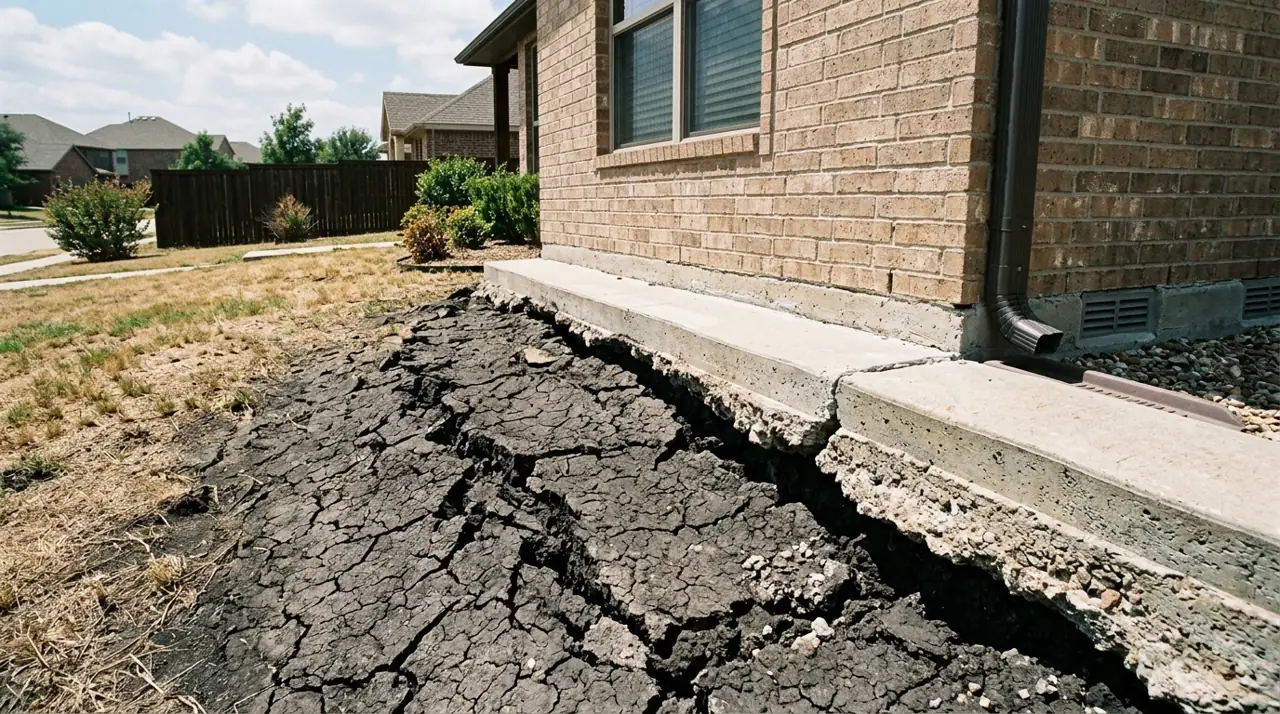
Every summer in North Texas, we hear the same advice: water your foundation during drought to prevent cracking. It's everywhere, from neighborhood Facebook groups to real estate blogs. But here's what actually happens when you follow that playbook without understanding the soil mechanics underneath.
The Trigger: Expansive Clay and the Boom-Bust Cycle
North Texas sits on Vertisols, soils with clay content reaching 60 percent or higher in some neighborhoods. Research on Dallas clay soils shows clay particles can change volume by 30 to 75 percent depending on moisture, far exceeding the stability of sandy or loamy soil. During droughts, this clay shrinks dramatically, pulling away from the foundation. When rain arrives, it expands again, pushing back. The cycle stresses concrete year after year.
The problem isn't just the shrinking or swelling alone, it's the differential movement. A shaded north side of your foundation may dry slower than the sunny south side, causing each section to move at different rates. Windows stick. Cracks form in unpredictable patterns. Walls separate from frames.
Why the Watering Advice Backfires
The conventional wisdom goes: keep the soil moist, prevent shrinkage, no cracks. Sounds logical, right? But this oversimplifies the problem in two critical ways.
First, consistent saturation from heavy watering can weaken the soil directly beneath your foundation. You're essentially creating a muddy base that loses its load-bearing capacity. Heavy clay under saturation doesn't gain stability, it loses it. Homeowners often water 15-30 minutes daily all summer, which is overkill. The soil 2-3 inches down only needs to feel slightly moist, not soggy. If you're creating standing water or mud near your perimeter, you've gone too far.
Second, you cannot maintain uniform moisture around the entire perimeter of your foundation without professional-grade irrigation. Most homeowners water the sunny side aggressively but neglect the shaded east and north sides, which already retain moisture longer. This creates exactly the differential drying that causes cracking in the first place.
What Actually Works: The Grading and Drainage Reality
The real solution isn't moisture management, it's water management. Your drainage and grading system determines whether water pools against your foundation or moves away from it. A properly sloped grade (at least 6 inches of fall in the first 10 feet from the house) and functioning downspouts that discharge 5-10 feet away accomplish far more than hand-watering.
If your foundation is already experiencing movement, forensic inspection can reveal whether the issue is active settlement, heave, or shrinkage cracking. The diagnosis determines the fix. Sometimes that means drains, sometimes underpinning, sometimes doing almost nothing because the movement has stabilized.
The uncomfortable truth: many North Texas foundations will crack. Clay soils move. It's not a failure of your home or the builder, it's the geology of Dallas County, Tarrant, Collin, and Denton. Hairline cracks in the first 2-3 years are common and often benign. The real concern is active, recurring movement after stabilization.
Seasonal Sense, Not Seasonal Panic
Here's a pragmatic take: light, infrequent watering in severe drought (like those 100-degree weeks with no rain) can reduce extreme shrinkage on the driest side of your house. But that's damage control, not prevention. It's the equivalent of band-aids on a structural issue that needs proper grading and drainage, not a garden hose.
If you live in North Texas and your foundation has been stable for 5-10 years post-construction, seasonal watering is probably unnecessary. If you're seeing active cracking now, adding water won't fix it. What will help is confirming the diagnosis with a structural engineering assessment, then addressing the actual mechanism: is water pooling, is the grade wrong, is there a buried drain that's failed, or is soil movement still active?
The best homeowner approach is simple: make sure your gutters work, ensure water slopes away from your house, avoid planting large trees within 20 feet of your foundation, and monitor for new cracks annually. That beats weekend watering with a soaker hose every time. If you're unsure whether your foundation needs monitoring or intervention, a pre-purchase inspection or phase-based assessment will answer that question without guesswork.
Disusun dengan bantuan AI dan ditinjau terhadap sumber publik yang dirujuk di atas. Bukan pengganti inspeksi bersegel PE.