
The Trigger
According to Google Trends data, Kansas ranks first and Texas second nationwide in foundation repair searches over the 12-month period spanning January 20, 2025, to January 20, 2026. That's not a random statistical blip. Kansas and Texas share environmental and construction characteristics known to increase foundation movement and structural stress. Expansive clay soils are a major contributor to foundation instability in both states. See the full analysis at Groundworks Foundation Repair Interest by State.
The question isn't whether that data is accurate. It is. The question is what it actually means, and more importantly, what it doesn't mean. A surge in search volume doesn't automatically equal a surge in real damage. It often means confusion about what you're looking at, and a market overcrowded with contractors offering the wrong fix.
Why North Texas Is Different: The Soil Mechanics
Texas is widely known for Houston Black clay soil (often called "Black Gumbo"), while clay-rich, montmorillonite-dominant soils are more common in Kansas. But DFW isn't defined by Houston's soil. We sit on Blackland Prairie clay, which is one of the regions with the highest concentration of shrink-swell clay soils in the United States.
These soils expand when wet and contract when dry. This shrink-swell soil cycle places stress on foundations from below, often leading to cracking, settlement, and structural movement. That's a simplification, but it's the core mechanism. What matters is not just that the clay moves, but how much it moves and how unevenly it moves.
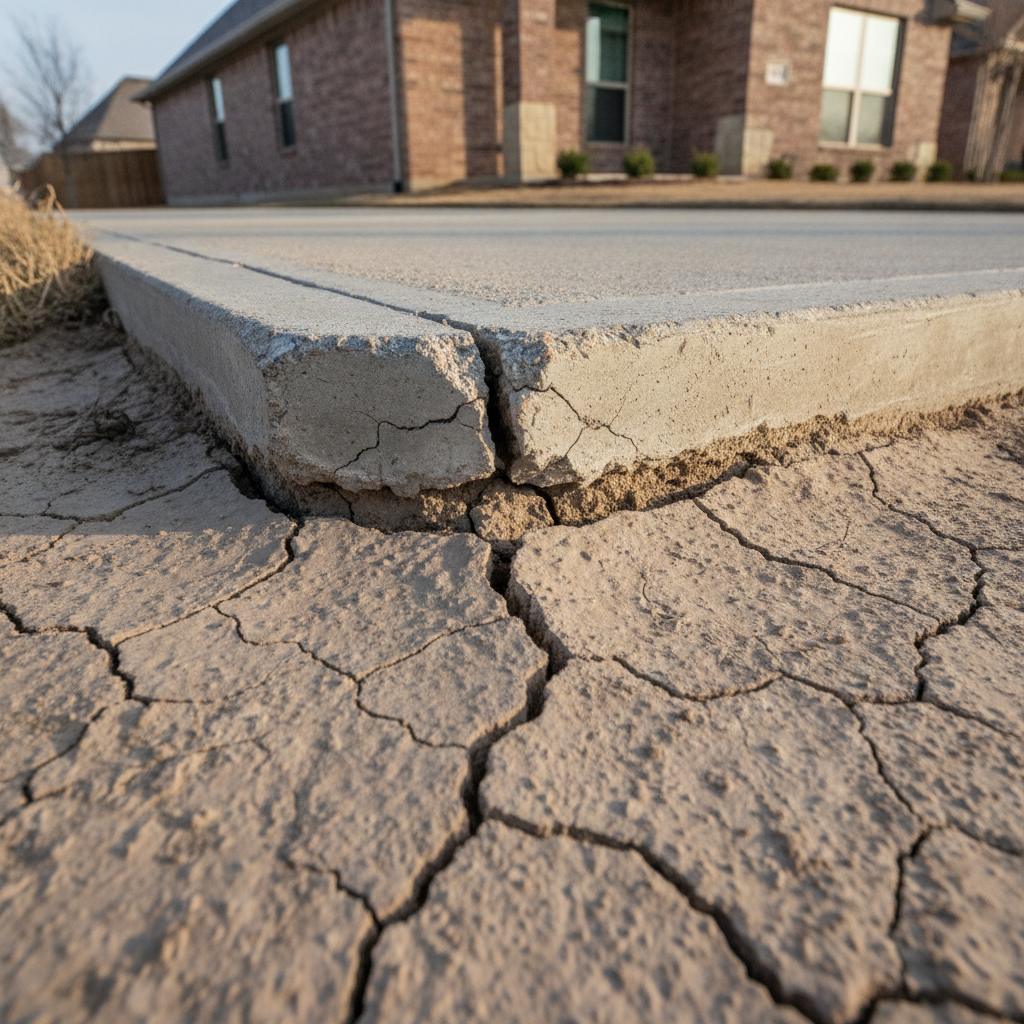
Clay soil in this region can change volume by 10 to 30 percent depending on moisture levels. That movement doesn't happen evenly. One side of a home might swell while another side sinks. This creates what engineers call differential movement. A 2-inch heave on one corner of your slab while the opposite corner stays put is not a uniform settlement problem. It's a bending moment. Your slab cracks because it's being twisted, not simply pushed down.
The pressure involved is massive. When saturated, clay can push upward with thousands of pounds of force per square foot. During dry periods, it pulls away and leaves gaps beneath foundations. That gap under the edge of your slab in August isn't just a cosmetic void. It's a stress concentration point. When that gap closes (and it will, when the next rain comes), your foundation redistributes load unevenly again.
Why Search Volume Matters, and Why It Doesn't
The spike in search interest reflects real movement. North Texas homes genuinely experience more foundation movement than most of the country. But it also reflects confusion. Homeowners see a stair-step crack in brick or a door that doesn't close flush, and they assume structural failure. Many do have real problems. Many don't. The contractors advertising in those search results know the difference between "this needs immediate underpinning" and "this needs moisture management and monitoring," but they don't always say so upfront.
A crack doesn't automatically demand piers. A gap in the soil doesn't automatically demand chemical stabilization. But neither should they be ignored. The issue is diagnosis, not panic. When a repair fails, a "free estimate" from another repair company isn't enough. You need a technical diagnostic. That diagnostic tells you whether your foundation is moving actively, how much, in what direction, and whether the movement is dangerous or just cosmetic.
The search surge reflects a market where homeowners are rightfully concerned, but many lack the engineering language to separate real risk from contractor upsell. That's the real problem.
What You Should Actually Do
If you're in North Texas and you've noticed cracks, movement, or gaps under your slab, start with a professional foundation inspection from a licensed engineer or qualified inspector. Not a contractor. An engineer who has no repair contract to sell will give you straight answers about whether your foundation is actually moving, how much, and what should happen next.
Maintaining consistent soil moisture, monitoring drainage systems, and scheduling periodic foundation inspections can help reduce structural movement. That means adequate drainage away from the perimeter, avoiding over-watering near the slab edge, and documenting the condition of your foundation over time. Most North Texas homes don't need $10,000 repairs. They need a baseline inspection, a monitoring plan, and clear criteria for when to intervene.
If your engineer does recommend repair, ask why. Is it because the foundation is moving unsafely now, or because modeling predicts movement over the next ten years? Is the recommendation underpinning, moisture control, or both? A good repair strategy often includes both: stabilizing the bearing surface below (piers or chemical stabilization if needed) and controlling moisture above (drainage, landscaping, consistent watering in dry months).
The fact that Texas ranks #2 in foundation repair searches is not a call to panic. It's a call to get clear information early. The cost of that inspection is minimal compared to the cost of choosing the wrong repair method, or choosing no repair and watching the problem accelerate. North Texas soil is unforgiving. It rewards those who act on engineering data, not those who wait for the next season's movement to make the decision for them.
Related: Pre-Purchase Inspection · Structural Engineering Assessments · Drainage and Grading
Disusun dengan bantuan AI dan ditinjau terhadap sumber publik yang dirujuk di atas. Bukan pengganti inspeksi bersegel PE.